
Stepping stones to Maturity:
1991
Earthquake Safe Housing
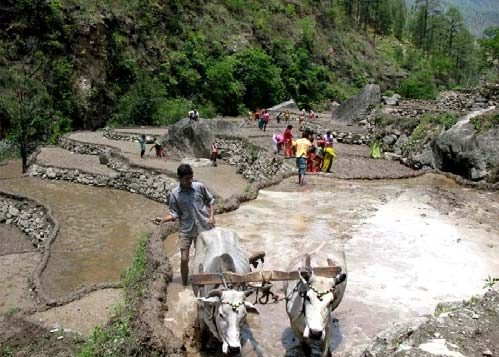
After the Uttarkashi earthquake in 1991 we published an 8-page Hindi booklet explaining EQ-safe housing construction principles and methods, using simple line sketches. Later the district administration distributed it in all the villages as an 8-poster set.We trained local masons to build EQ-safe houses. Publishing literature in local languages, training local masons, working with district authorities and building EQ-safe structures became an established post-EQ response at PSI.
1992-93
Scaling Up A Pioneering Programme to District Level
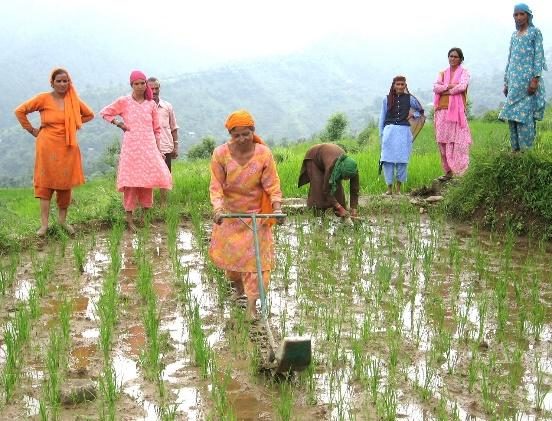
PSI coordinated the Sukha Mukti Abhiyan, in response to the severe drought of 1992-93 in Palamu district. We created a unique 3-way partnership of Pani Panchayats (villagers’ implementing agencies), district administration (funding agency) and the PSI-led Pani Chetna Manch (PCM) consisting of local youths (coordinators) to implement a drought-proofing programme. In 2 years PCM guided Pani Panchayats in 125 villages to build 143 earthen dams, with an irrigation potential of about 4000 acres, and manage expenses totalling Rs 2.70 crores. The Indian Government later adapted many SMA procedures to prepare the National Watershed Development Programme guidelines.
1996
A Regional Training Centre Emerges
In 1996 the Council for Advancement of People's Action and Rural Technologies (GoI) selected PSI to train and support organizations implementing participatory watershed development projects in north India. Several states’ agencies and district administrations recognized our Centre for Participatory Watershed Development (CPWD) as a training centre.
CPWD established its own watershed development programme for NGOs in Himachal Pradesh and Uttarakhand with financial support from Sir Ratan Tata Trust. Between 1996 to 200X, it supported 47 NGOs in participatory watershed development, clocking over 36,000 trainee-days.
1999
Innovating Temporary Shelters
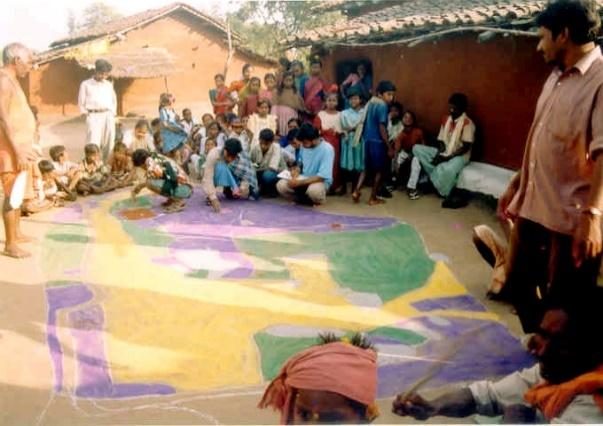
Homeless people need more than a year after a major disaster to build their permanent homes. In the interim they need secure temporary shelters with basic amenities to live. After the Latur EQ, the state government built 170sq ft. tin sheds for 8250 families in three weeks. Learning from Latur, we innovated several designs to suit the local environment after major disasters in different states. Since 1999 we have built a few thousand temporary shelters. The building materials used included tin sheets, roofing tiles, water-proof reinforced burlap and tin sheets with insulation. We also built schools in Odisha and Kachh.
2000
From Consumption to Conservancy
Over millennia, Himalayan communities have built rain water harvesting structures that have functioned for centuries. They are living examples of sustainable technologies. In response to growing water supply problems in rural Himachal and Uttarakhand in the 1990s, we researched and analysed their water histories. An extensive outreach effort to villagers, panchayats, activists and officials included publication of a monograph and a popular quarterly Hindi newsletter; photo-exhibitions, meetings, workshops, exposure tours for villagers, live demonstrations of appropriate technologies and state-level conferences. It created tremendous interest in reviving defunct water harvesting structures, and making water policy recommendations in both states.
Between 2000 and 2005 we implemented two large watershed projects in Pauri Garhwal (Uttarakhand) and Hamirpur (H.P.) districts, spanning almost 10,000ha in 100+ villages. Watershed villages in Hamirpur district suffered annual water shortages. Women being the main household water gatherers, we focussed on mobilizing women power. The response was stupendous. When the project ended no tankers were required to supply water in these villages. Surplus watershed villages supplied villages beyond the watershed. The people of Dabkerh and Bhusal villages installed their own water supply systems replacing the state water supply agency!
2002
Poor People Become Changemakers
After reports of starvation deaths in the Western Odisha’s KBK region in 2001, PSI began the Gram Swaraj Abhiyan (GSA) on the request of the PMO and Sahabhagi Vikash Abhiyan (SVA), a local organization. Our initial recces revealed that the deaths were more due to rural indebtedness than starvation. We initiated GSA to strengthen grassroots democracy so that the poor become subjects of development rather than its objects. We trained a cadre of local activists and village resource persons. 314 villages prepared their own development plans. Village-level institutions and the resource persons began ensuring that mandated government services, were duly available to the villagers. It led to enhancing livelihood opportunities and incomes, especially for the very poor.
2006
Agro-ecology Transforms Farmers Lives
Decreasing farm holdings and low productivities of farms in Himachal and Uttarakhand force most farmers to annually purchase substantial rice and wheat, their staple foods. To enhance their farm productivities, in 2006 we began promoting the System of Crop Intensification (SCI) among them. Using agro-ecological principles, we demonstrated that with less seeds, water and switching to organic manure, crop productivities could increase from 40% to over 100%. Lower input costs and higher production increased money. Later, with state and NGOs’ support, we extended SCI to other crops like maize and rajma and enabled thousands of farmers annually to successfully adopt SCI principles on trial plots in Himachal, Uttarakhand, Bundelkhand and Odisha.
“In 2012 I harvested 980kg of wheat from my farm, which had never yielded more than 640kg, using the SCI principles. I cut my market wheat purchase from 600kg to only 300kg.” -- Paras Ram, a Dalit farmer in Hamirpur (H.P.)
2009
Community Action Eliminates Fluorosis
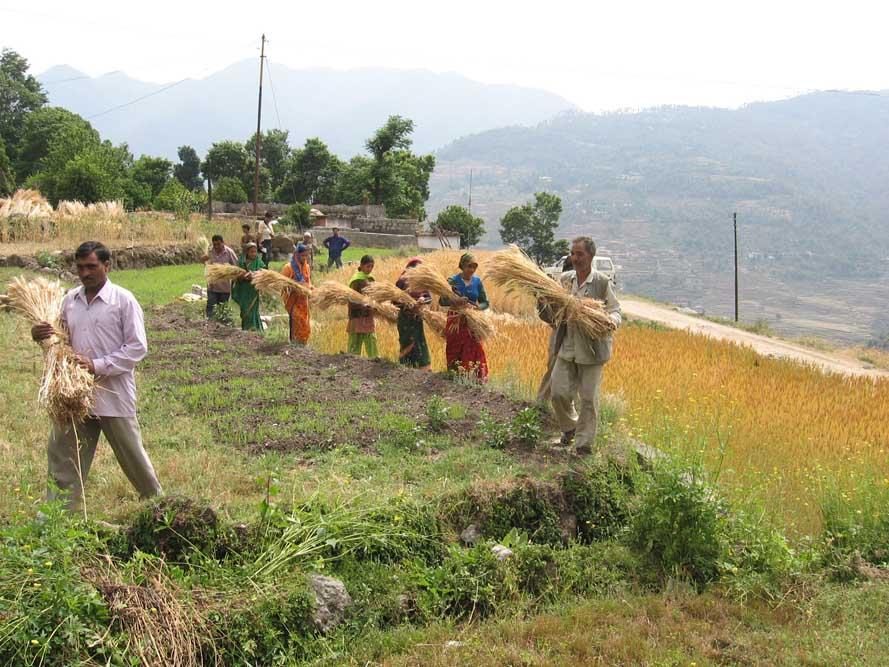
Fluorosis is a crippling disease caused by fluoride contaminated drinking water. Fluoride concentrations below 1.0mg/l are considered safe. In 2025 the Central Ground Water Board identified 263 districts (36%) with problem areas. Between 2009-2014 PSI’s Environment Quality Monitoring Group combined hydrogeology, water quality testing and community action to successfully implement a simple, sustainable, low-cost fluorosis mitigation approach in X villages of Dhar (M.P.) and Sonebhadra (U.P.). It benefitted Y persons. Urinary fluoride concentrations reduced by YY%, indicating a success for the programme.
2010
Bundelkhand
Impressed by PSI’s GSA programme in Odisha, MoRD approached us in 2010 to implement a similar programme of poverty eradication through self-reliant development in Bundelkhand. In Bundelkhand, the focus was on training village youths as local resource persons, establishing trained village level institutions, empowering women, and improving food, nutrition and livelihood security in a socially-just manner. The latter include farm ponds for irrigation, SCI, NPM, vegetable cultivation and marketing surpluses. In 14 years, we have reportedly helped increase family incomes by 15K to 20K per year (FY24), benefitting an estimated ABCD households (abcd persons) in xyz villages of M districts. The villagers established 125 Farmers Interest Groups (FIGs), QRS Savings & Credit Groups, Total savings, annual lending?
2019
E-Flow Assessment of major rivers in Uttarpradesh (2019-20)
Developing minimum flow requirement to meet the socio-cultural needs of rivers through study done across 8 rivers of Uttar Pradesh, supported by WWF-India.
Rivers, though being the source of livelihood for millions of Indians, have been facing severe degradation due to increasing water pollution. PSI, along with Uttar Pradesh Water Management and World Wide Fund for Nature - India (WWF-India), did a significant E-flow assessment of all eight major rivers in the state of Uttar Pradesh. This included checking the quality, quantity and required quantity of water that is needed to maintain the freshwater ecosystem.
The task was completed in two phases, wherein in Phase-1, the Sharda, Ghaghra, Gomti, Rapti and additional sites of Ganga were taken up for E-Flows assessment, whereas in Phase-2, Yamuna, Gandak and Sone were assessed. Along with PSI, the project also had significant contributions from other stakeholders such as cGanga IIT Kanpur, Terraqua UAV IIT Kanpur and ICAR-NBFGR Lucknow. The initiative culminated in key recommendations for the state government and WWF-India to ensure adequate water depth, quality, and river flow for the protection of aquatic biodiversity and species.
2020
Development Practitioners Training Course (DPT)
PSI leads one of the most comprehensive programmes in the country to train the professionals for the development sector. The ‘development practitioner training course(DPTC)’ which is a ten months intensive programme has successfully trained four batches since its inception in 2020.
The program was intended to prepare the youth to develop skills such as critical skills, field knowledge and practice knowledge to effectively contribute to grassroot development.
2022
Shallow aquifer management (2022-23)
The Shallow Aquifer Management was a pilot project under government-run program Amrutam 2.0 which aimed to revive and recharge Gwalior’s declining shallow groundwater sources. It was a joint collaboration that involved NIUA, Gwalior Municipal Corporation, People’s Science Institute, ACWADAM and BIOME Environmental Trust. The project used mixed methods consisting of field surveys, groundwater data, hydrogeological studies and mapping of underground flow to extract data which was later used to identify the suitable recharge areas. The team initially assessed 20 sites, out of which 6 sites were finalised to pursue the project. These sites included check dams, recharge wells, rainwater harvesting systems and ponds. Based on Gwalior’s geological and urban conditions, the team then developed a roadmap to support shallow aquifer management and identify priority areas for groundwater recharge.
Irrigation Fodder Development
2022
System mapping of air quality pollution (2022-23)
PSI conducted a study which focused on local stakeholders and communities’ knowledge in combating the rapidly increasing air pollution in Indian cities, the data was collected from four major Indian cities that is Ahmedabad, Bhuvneshwar, Indore and Mumbai. The study was funded by the USAID and Government of India. The team interviewed major stakeholders, documented the engagement around civic issues and studied resources to understand the ground reality of policies and engagement on pollution. The analysis produced a comprehensive report that covered the community’s understanding of air pollution and mobilisation around it to a mainstream framework of knowledge. It also pointed out the opportunities that USAID can have with the local actors and implement the local knowledge on policy level.
2025
Gram Panchayat Resilient Plans (2025-2026)
The mountain communities are heavily dependent on the Himalayas for their livelihood. However, rapid melting of glaciers due to climate change have increased the vulnerabilities of the communities dependent on the mountains. This project involved the development of ten gram panchayats of Uttarakhand that are located within the Song and Kosi basins. The aim was to strengthen existing institutions and communities to identify the climate risks and develop adaptation strategies that are embedded in communities’ everyday practices.
PSI’s team developed a Standard Operating Procedure keeping each village's needs and social context as the foundation of the implementation. Each of these SOPs consisted of the different stakeholders of state governments, identifying the key climate risks and their social economic consequences. This GPRP framework ensured that the planning and execution of the disaster mitigation initiatives remain and get strengthened in the hands of local decision-making stakeholder